The short answer is “Yes, quite a few” but these blog posts would be a lot more frequent if the short answers were good enough. (Side note: I plan on posting at least once a week). Today, many students like myself go straight into postgraduate study upon finishing their undergraduate degrees and others often intend on returning to pursue further study in the near future. There are many reasons to do this: from a personal point of view another year in college offers the opportunity to grow, immersed in an intellectual environment. In the more pragmatic sense, a postgraduate qualification can add to your employment prospects in a world where so many are now attending higher education after second level. It may even be a requirement in order to enter a specific profession or they may wish to obtain more specialized skills in their particular field. (You can probably tell I worked as an assistant at the college careers service for 2 years).
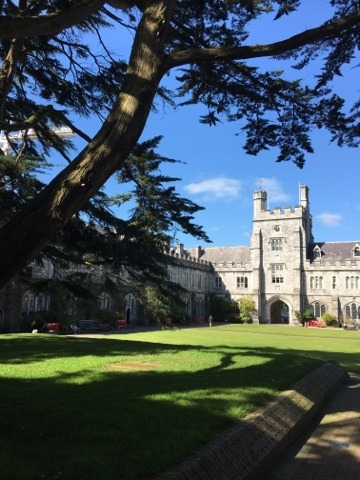
Personally I entered into my MA for two reasons, the first being that I simply thought it would be enjoyable. I always feel privileged by the fact that what I study academically also happens to be what I am truly passionate about, therefore of course I was eager to advance my studies of English Literature to a higher level having (in all modesty) performed quite well in my primary BA. Basic mentality: “I’m really good at this and it makes me happy so why not do more of it?”. In my final year I had friends who were studying on the MA programmes at our university (old UCC nicely photographed above) and they spoke highly of the experience and the programmes had been recommended by our lecturers towards the end of term. With all this and my aforementioned experience in the careers service I was well aware of the postgraduate opportunities on offer but it was something else that confirmed the specific masters degree I wished to pursue. Early in my final semester I was invited by one of my lecturers to attend the Textualities Conference, an annual event run by the MA classes of the School of English to showcase their developing research projects. Seeing the fascinating and diverse range of topics being explored by these students, some only a year older than I was at the time confirmed my goal: final results willing I would be a student on the MA in Modern Literature and Film the following year. One 1st class honors BA later, here we are. This reminiscing leads me to my second reason for wanting to pursue postgraduate studies in the first place: a dream career. Though I am now coming to the end of my MA and it is my intention to take a year or two off from the academic world in order to work, it is still my ambition to pursue a PhD to become a professional scholar, contribute to the field that I am so passionate about and perhaps help to ignite that interest in others as a lecturer someday. (Also how great will it be to be able to do Doctor Who cosplays as an actual doctor?)
Self aggrandizement and jokes aside what I really wanted to share in this post were some of the key differences between undergraduate and postgraduate student life. A few years back I wrote a similar piece on the differences between secondary school and university for incoming first years which was published in a local paper, so consider this a spiritual sequel. First and foremost you will notice the smaller class sizes, if like myself during your undergraduate degree you had lectures that could have under 100 people in one room on a slow day. This smaller group size leads to a more personal learning experience and you will also get to know your lecturers better, which will help when it comes to choosing a supervisor for your thesis (but more on that at a later date). On a more social level, being in a tight-knit group with people who share this specialized interest at postgrad level you may make some new friends, some possibly from outside your university and country. Making these connections was one of the highlights of my MA experience (sorry enough about me!). Furthermore there is often more of a focus on self-directed learning that comes with this more one-to-one environment. As a subject English is often very self-driven as it is up to you to read the books, plays, poems etc given, but as a postgrad things are taken a step further as we were encouraged to think more as scholars and critics than learners, to research different sources of information and formulate our own opinions. Which brings me to my final point: the more specialized course content. Often at undergrad there is a focus on exposing students to as much of their academic fields as possible, thus throughout your degree you will most likely encounter one or two areas that were not to your liking. At postgrad because you are working towards narrowing your research focus you have the unique opportunity to choose to study the areas that interest you most. Taking English once again as an example (its all I know) I studied Modern Literature, so the modules I took were focused on texts written no later than the 1800s, whereas other MAs specialized in Medieval Literature and other periods.
I hope hearing from the experience of one student who decided to keep living that intellectual life for a little longer after receiving his first degree has given you some idea of the difference between the undergrad and postgrad experience. Lastly while I attended the same university for both degrees, for many of you this may not be the case. Of course the change of scenery may make you feel more intimidated, but trust me as someone with friends who were in the same situation, you will be fine. As cliché as this sounds, though some things change when you make this leap into the higher levels of education, as long as you keep doing your best, remain focused and keep that passion burning you’ll soon have another degree on the wall.
As Oscar Wilde said “I always pass on good advice. It is the only thing to do with it, it is never of any use to oneself.”
 The Scholar’s Notebook